
Batu Ferringhi Travel Guide
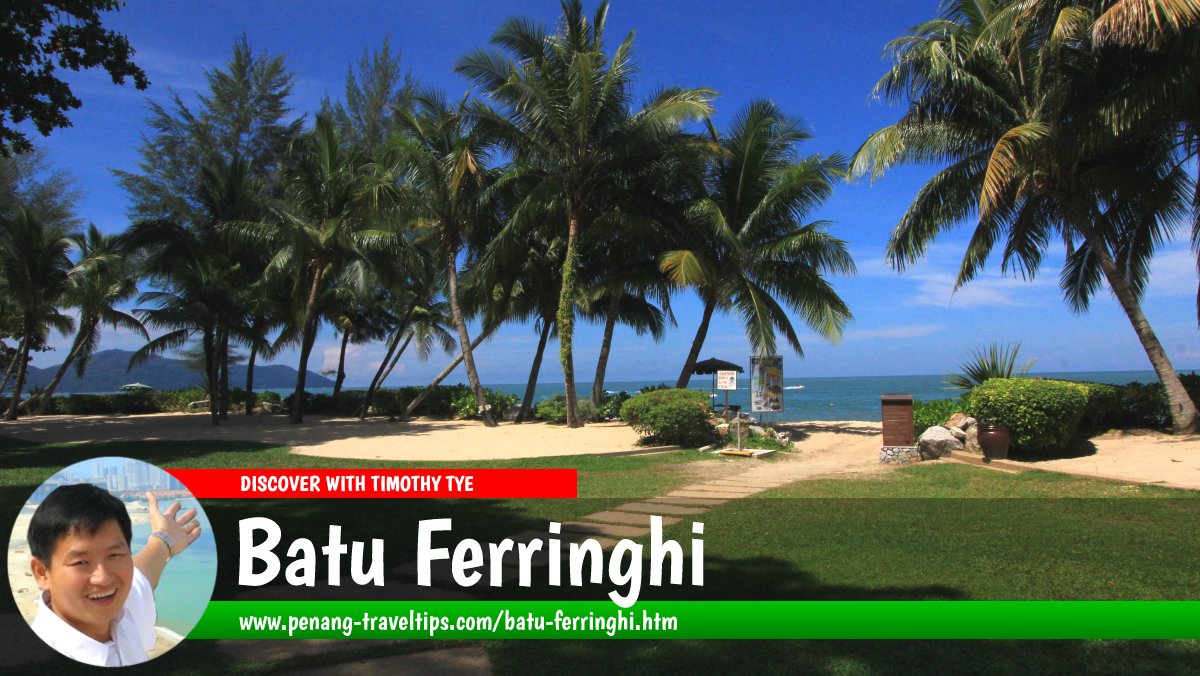 Batu Ferringgi, Penang (7 December 2014)
Also available: Panduan Melawat Batu Ferringhi
Batu Ferringhi (GPS: 5.47295, 100.24735), also commonly spelled Batu Feringgi and known in Chinese as 峇都丁宜 (Bādōu Dīngyí), is Penang Island's best-known beach resort district. Located along the island's northwestern coast, it is characterised by a long sandy shoreline, large coastal boulders, beachfront resorts, restaurants and a lively night market. Since the 1970s, Batu Ferringhi has developed from a relatively quiet coastal settlement into one of Penang's principal holiday destinations, attracting Malaysian and international visitors seeking a beachside stay. 1
Quick Facts
- Name: Batu Ferringhi / Batu Feringgi
- Chinese name: 峇都丁宜 (Bādōu Dīngyí)
- Location: Northwestern coast of Penang Island, Penang, Malaysia
- Approximate coordinates: 5.47295° N, 100.24735° E
- Geographical setting: Coastal resort area facing the Strait of Malacca
- Known for: Sandy beaches, resort hotels, water sports, coastal scenery and the night market
- Nearby destinations: Tanjung Bungah, Teluk Bahang, Tropical Spice Garden and Penang National Park
- Best time to visit: Early morning for a quieter beach walk; late afternoon and evening for sunset and the night market
- Transport: Car, taxi, e-hailing services and Rapid Penang buses
- Suitable for: Beach holidays, family trips, resort stays, dining and evening shopping
Geography and Coastal Landscape
Batu Ferringhi lies on the northern coast of Penang Island, northwest of George Town. The main coastal road, Jalan Batu Ferringhi, follows the shoreline and links the resort district with Tanjung Bungah to the east and Teluk Bahang farther west. The area forms part of a broader coastal corridor that combines residential neighbourhoods, hotels, beaches and natural attractions. 1
The coastline is characterised by sandy stretches interspersed with large granite boulders and rocky sections. Some parts of the beach are broad and open, while others are narrower or have more rocks along the water's edge. Trees and tropical vegetation provide greenery behind sections of the shoreline, although the degree of shade and the appearance of the beach vary from one location to another.
The sea at Batu Ferringhi forms part of the Strait of Malacca. Its water is not consistently clear or turquoise, and its appearance can change with rainfall, tides, wave conditions and suspended sediment. Visitors should therefore distinguish between a beach that is attractive for walking and recreation and one where swimming conditions are suitable on a particular day.
On clear days, parts of the northern mainland and the distant landscape towards Kedah may be visible from the coast. Gunung Jerai, also known as Kedah Peak, is a prominent mountain in Kedah, although visibility depends on atmospheric conditions and the viewing position.
The coastline is also affected by natural processes such as wave action, erosion and the movement of sand. Large boulders and rocky outcrops are part of the local coastal landscape, but individual rocks can become slippery when wet. Visitors should take care when walking near the water or climbing over rocks.
History of Batu Ferringhi
Before the resort era
Before the growth of modern tourism, Batu Ferringhi was a much quieter part of Penang's northern coast. Its coastal setting and distance from the historic commercial centre of George Town gave it a different character from the island's older urban settlements. Fishing, small-scale settlement and movement along the coastal road formed part of the wider history of this stretch of the island.
Although the area is now closely associated with hotels and tourism, its name is much older than the resort industry. The word Ferringhi belongs to a wider family of terms used across parts of Asia, the Middle East and Africa to refer to Europeans or Western foreigners. Its history reflects centuries of contact between different peoples through trade, migration and travel. 2
The development of beach tourism
The modern transformation of Batu Ferringhi accelerated from the 1970s, when large hotels and resorts began to establish a presence along the coast. Tourism development continued through the following decades, with additional hotels, restaurants, residential properties and leisure facilities changing the character of the area.
The opening of major beachfront resorts helped establish Batu Ferringhi as Penang's principal beach holiday district. Accommodation was no longer limited to small local establishments: larger resorts began offering swimming pools, landscaped grounds, restaurants, recreational facilities and direct access to sections of the beach.
Further hotel and condominium development followed along the coastal road. As the resort district expanded, Batu Ferringhi became a destination where visitors could spend several days without needing to travel to George Town for every meal or leisure activity. Nevertheless, many travellers continue to combine a beach stay with sightseeing and food excursions elsewhere on the island.
The night market and visitor economy
The Batu Ferringhi night market became one of the area's most recognisable features. Stalls selling clothing, souvenirs, accessories and other goods developed along the main road, providing an evening activity for hotel guests and day visitors alike. The market contributes to the district's lively atmosphere after sunset and complements the restaurants and other businesses serving the resort area. 1
Today, tourism remains central to Batu Ferringhi's identity. Hotels, restaurants, leisure operators and retail businesses serve both international travellers and Malaysians taking short holidays. At the same time, residential areas and everyday services remain part of the wider district.
Origin and Meaning of the Name
The name Batu Ferringhi consists of the Malay word batu, meaning rock or stone, and ferringhi, a historical term associated with Europeans or Western foreigners. The name is commonly interpreted as “Foreigner's Rock” or as a reference to a rocky coastal place associated with Western visitors. 2
The word ferringhi, also written feringgi or peringgi in historical and modern usage, has linguistic connections with terms used in other parts of Asia. These include Thai farang and related forms in other regional languages. The words are associated with older terms for Franks or Europeans, transmitted through historical contact and linguistic borrowing. The precise route by which each form entered a particular language is more complex than a simple direct translation.
It is therefore reasonable to explain the name as a reference to rocks and Western foreigners, but the popular story that a specific group of Portuguese sailors landed on a particular rock at Batu Ferringhi should not be presented as established fact without documentary evidence.
Batu Ferringhi or Batu Feringgi?
Both Batu Ferringhi and Batu Feringgi are encountered in published material. The former is widely used in hotel names, travel publications and everyday references, while the latter reflects a spelling used in Malay-language official and local contexts. Tourism Malaysia, for example, uses the spelling Batu Feringghi in its English-language tourism material. 1
In 2019, the Penang state government announced that the Malay spelling would revert to the gazetted form Batu Feringgi. However, Batu Ferringhi remains widely recognisable in English-language tourism and commercial usage. This guide uses Batu Ferringhi for consistency with the page title and the familiar English spelling.
Places of Interest in Batu Ferringhi
1. Batu Ferringhi Beach
The beach is the main attraction of the district. Its long coastal stretch offers space for walking, relaxing by the sea, watching the sunset and enjoying views of the surrounding landscape. Some sections are lined by resorts, while others have more open stretches of sand and prominent boulders.
Early morning is often a pleasant time for a walk, when the beach may be quieter and the weather cooler. Late afternoon offers another opportunity to enjoy the coast, particularly when the sun begins to set over the Strait of Malacca. Weekends and school holidays can be busier, especially near the main hotels and popular recreation areas.
Although the beach is widely visited, swimming conditions are not guaranteed. Water quality, currents, waves and the presence of jellyfish can vary. Check local advice and warning signs before entering the sea, and do not swim when conditions are unsafe.
2. Lovers' Isle and the Rocky Shoreline
Lovers' Isle is a name associated with a small rocky outcrop at the western end of the Batu Ferringhi coastal stretch, towards Teluk Bahang. The area has also been associated with the older name Ujong Batu. The name Lovers' Isle appears to have gained some popularity in the twentieth century, although it is less prominent in everyday usage today.
The rocky shoreline and large boulders are visually distinctive features of this part of the coast. They provide a contrast to the sandy beach sections and are of interest to visitors who enjoy coastal photography. However, the historical relationship between the name of the outcrop and the origin of the wider place name has not been conclusively established.
Take care when approaching rocky sections. Waves can wash over rocks unexpectedly, and wet surfaces may be slippery. Do not attempt to cross exposed rocks during rough seas or enter areas marked as unsafe.
3. Batu Ferringhi Night Market
The Batu Ferringhi night market is one of Penang's best-known evening shopping areas. It operates along the main road through the resort district, with vendors offering a variety of goods, including clothing, accessories, souvenirs and decorative items. The selection varies between stalls and can change over time.
The market is especially convenient for visitors staying in nearby hotels, many of which are within walking distance of at least part of the shopping strip. It is also a popular stop for travellers who arrive from George Town for an evening at the beach and a meal.
Opening hours and the number of stalls may vary with weather, public holidays and local arrangements. Visitors should check current conditions rather than assume that every stall operates at the same time each evening.
When shopping, compare prices before buying and ask about the price clearly. Some vendors may be open to reasonable negotiation, particularly for souvenirs and non-priced items. Keep personal belongings secure in crowded sections and be considerate of other pedestrians along the roadside.
4. Beachfront Resorts and Leisure Facilities
Batu Ferringhi has a concentration of hotels and resorts offering a range of accommodation and leisure facilities. Some properties have direct beach access, while others are separated from the beach by the coastal road or are located farther inland. Facilities vary from one property to another.
Many resorts provide swimming pools, restaurants, landscaped gardens and activities for families. Some also offer spa services, children's facilities or organised recreational programmes. These amenities are generally intended for registered guests, and visitors should confirm access arrangements before planning to use hotel facilities without an overnight booking.
5. Tropical Spice Garden
The Tropical Spice Garden is located along the coastal road between Batu Ferringhi and Teluk Bahang. It is a landscaped tropical garden with collections of herbs, spices and other plants, together with trails that introduce visitors to tropical vegetation. Tourism Malaysia identifies the garden as a major nature attraction on Penang's northern coast. 3
The garden offers a change of pace from the beach and resort environment. Visitors can explore plant collections and learn about the uses of tropical herbs and spices. It is particularly suitable for travellers interested in nature, gardening and the relationship between plants and regional food traditions.
Check the garden's official visitor information for current opening hours, admission charges and any scheduled activities before visiting.
6. Teluk Bahang and Penang National Park
Teluk Bahang lies farther west along the coastal road and provides access to a different side of Penang's northern coastline. The area is associated with fishing, nature-based tourism and the entrance to Penang National Park.
Visitors who wish to extend their trip beyond Batu Ferringhi can explore the park's forest environment and coastal attractions, subject to current access arrangements. Some destinations within the park require walking trails or boat transfers, and availability can depend on weather and park management. Check official park information before setting out.
Activities at Batu Ferringhi
Beach walks and sunset viewing
A walk along the beach is one of the simplest ways to experience Batu Ferringhi. The shoreline is especially attractive when viewed from a distance, with sand, boulders, trees and resort buildings forming a varied coastal landscape.
Sunset is a popular time for photography and relaxing by the water. The exact position of the sun changes throughout the year, and cloud cover can affect the view. Choose a safe spot away from vehicle traffic and avoid standing on unstable rocks for photographs.
Water sports
Water-sports operators have traditionally offered activities such as jet skiing, parasailing and banana-boat rides along sections of Batu Ferringhi Beach. Availability depends on the operator, weather, sea conditions and any restrictions in force at the time of the visit. 1
Before paying, ask about the duration of the activity, the total price, safety equipment, age or health restrictions and whether the operator is authorised to conduct the activity. Follow instructions from the crew and do not participate when weather or sea conditions are unsuitable.
Horse riding
Horse riding along or near the beach has been offered in the Batu Ferringhi area at various times. The availability and permitted riding locations can change, so visitors should not assume that a ride can be arranged on arrival. Check with a legitimate operator and confirm where riding is allowed before making arrangements.
For safety and consideration of other beach users, follow the operator's instructions and avoid riding through crowded swimming or walking areas.
Shopping and evening entertainment
The night market and nearby commercial premises provide evening activities beyond the beach itself. Visitors can browse for souvenirs, stop for refreshments or dine at one of the restaurants along the resort strip. Some hotels also offer their own entertainment and dining programmes.
As the main road can become congested during busy periods, allow extra time when travelling between the night market, restaurants and accommodation. Where possible, walk between nearby destinations instead of repeatedly moving a car through crowded areas.
Food and Dining in Batu Ferringhi
Batu Ferringhi has a broad range of dining options serving hotel guests, local residents and day visitors. These include restaurants, cafés, casual eateries and food outlets within shopping and resort areas. The choice ranges from Malaysian dishes to international cuisine, reflecting the district's role as a destination for visitors from different countries.
Malaysian food
Visitors may find familiar Malaysian dishes such as nasi lemak, rice with assorted dishes, fried noodles, soups and local snacks, depending on the restaurants and stalls operating at the time. Some eateries specialise in seafood, while others offer casual meals suited to families and groups.
For a wider selection of traditional hawker food, visitors can also travel to other parts of Penang, including George Town. Batu Ferringhi's dining scene is closely linked to its resort and tourist character, so prices and menus may differ from those at neighbourhood food centres elsewhere on the island.
Seafood and beachfront dining
Seafood restaurants are a familiar feature of Batu Ferringhi. Menus may include fish, prawns, squid, crab and other seafood dishes, prepared in Malaysian or international styles. Some restaurants offer outdoor seating or views towards the sea, although not every establishment is directly on the beach.
Before ordering seafood priced by weight, confirm the weight, preparation method and final cost. Ask whether service charges or other fees apply, particularly when ordering several dishes for a group.
Halal food for Muslim visitors
Muslim visitors can look for Malay restaurants and other establishments that clearly identify their halal status. However, the presence of seafood or Malaysian dishes on a menu does not automatically establish that a restaurant is halal. Where halal certification is important, check for reliable certification or ask the restaurant directly about its ingredients and food preparation arrangements.
During weekends and school holidays, popular restaurants can become busy around dinner time. If you are travelling with a large family or group, consider arriving early or confirming whether the restaurant accepts reservations.
Where to Stay in Batu Ferringhi
Batu Ferringhi is one of Penang's principal areas for beach resort accommodation. Its hotels range from established beachfront resorts to smaller hotels, guesthouses and serviced apartments. This makes the district suitable for travellers who want to spend much of their holiday near the sea rather than in the historic centre of George Town. 4
Beachfront resorts
Beachfront resorts are suitable for visitors who prioritise direct beach access, swimming pools, restaurants and on-site leisure facilities. Examples in the area include Shangri-La Rasa Sayang Resort & Spa, Shangri-La Golden Sands Resort, PARKROYAL Penang Resort, Hard Rock Hotel Penang and Bayview Beach Resort. The facilities, room categories and prices differ between properties.
Not every hotel advertised as being in Batu Ferringhi sits directly on the sand. Check the exact location, access to the beach and available facilities before booking, particularly if travelling with young children or anyone with limited mobility.
Smaller hotels and apartments
Smaller hotels, guesthouses and serviced apartments may suit travellers who prefer a more independent stay or have a lower accommodation budget. Some are within walking distance of the beach and night market, while others require transport to reach the main resort strip.
For apartment or homestay accommodation, verify the exact address, parking arrangements, check-in procedure and whether short-term stays are permitted by the property management. A listing that uses the name Batu Ferringhi may cover a wider area than the beachfront itself.
Should you stay in Batu Ferringhi or George Town?
The choice depends on the purpose of your trip. Batu Ferringhi is convenient for a beach holiday, resort facilities, water sports and evening shopping. George Town is generally more convenient for exploring heritage buildings, museums, traditional markets and the island's wider hawker-food scene.
Travellers with enough time may divide their stay between the two areas. This allows them to explore George Town without making a return coastal journey every day, while also enjoying a few nights at a beach resort.
How to Get to Batu Ferringhi
By car
Batu Ferringhi can be reached by road from George Town and other parts of Penang Island. The usual route from George Town follows the northern coastal corridor through Tanjung Tokong and Tanjung Bungah before continuing along Jalan Batu Ferringhi towards the resort district.
The drive is straightforward in normal conditions, but journey times can increase during weekends, school holidays, public holidays and evening periods. Traffic may be especially slow around popular hotels, restaurant areas and the night market. If you are driving, allow extra time for parking and avoid stopping in places that obstruct traffic.
By Rapid Penang bus
Rapid Penang buses provide a public transport option for reaching Batu Ferringhi from other parts of the island. Route 101 has served the corridor between the George Town area and Teluk Bahang via the northern coast, including Batu Ferringhi. Routes, timetables and stopping arrangements can change, so check current information through Rapid Penang before travelling. 5
Bus travel is useful for visitors who do not wish to drive, but it may take longer than a car or e-hailing journey, especially during busy periods. Check the location of the nearest stop to your hotel or intended destination and allow for a walk along the coastal road if necessary.
By taxi or e-hailing
Taxis and e-hailing services are convenient for travel between George Town, Batu Ferringhi and other attractions along the northern coast. They are particularly useful for visitors carrying luggage or travelling with children. Fares and waiting times vary with distance, demand and traffic conditions.
For a late-night return journey, confirm that a vehicle is available before leaving a remote part of the beach. If travelling in a group, check that the selected vehicle can accommodate all passengers and luggage.
From Penang International Airport
Visitors arriving at Penang International Airport can travel to Batu Ferringhi by taxi, e-hailing service or a combination of public transport services. There is no need to assume that a single direct public bus will take you from the airport to every hotel in the resort area. Check the current route options and transfer requirements before departure.
By road, the journey crosses the island towards the northern coast. The time required depends on traffic, especially when passing through the more developed parts of George Town and Tanjung Bungah.
Getting Around Batu Ferringhi
The main resort district is arranged along a coastal road, making some hotels, restaurants and night-market sections accessible on foot. However, the distance between different parts of Batu Ferringhi can be considerable, and not every section has continuous, comfortable pedestrian facilities.
Walking is practical for short journeys between a hotel, a nearby restaurant and the night market. Take care when crossing the road, particularly after dark, and use designated crossing points where available. The coastal road can be busy, and drivers may be entering or leaving hotel driveways and car parks.
For destinations farther along the coast, such as Tropical Spice Garden or Teluk Bahang, consider a bus, taxi, e-hailing service or rental vehicle. If you plan to visit several attractions in one day, group them by location to reduce unnecessary travel along the same road.
Nearby Places to Explore
Tanjung Bungah
Tanjung Bungah lies between George Town and Batu Ferringhi. It combines residential areas, coastal scenery, hotels and local commercial facilities. It is a useful stop for visitors who want to explore more of Penang's northern shoreline without travelling far from the city.
Teluk Bahang
Teluk Bahang is farther west and has a quieter character in some parts of the coastal corridor. It provides access to nature attractions and Penang National Park, making it a suitable extension to a Batu Ferringhi trip for visitors interested in the outdoors.
Tropical Spice Garden
The Tropical Spice Garden offers an introduction to tropical plants, herbs and spices in a landscaped setting. Its location along the road towards Teluk Bahang makes it possible to combine a garden visit with a coastal drive.
Penang National Park
Penang National Park protects a section of the island's northwestern coastline and forest environment. Access to individual trails and beaches depends on park regulations, weather and current conditions. Visitors should check the official information before planning a hike or boat transfer.
Suggested Itineraries
One evening in Batu Ferringhi
- Late afternoon: Arrive at the beach for a walk and enjoy the coastal scenery.
- Sunset: Find a safe place to watch the changing light over the Strait of Malacca.
- Dinner: Choose a restaurant along the resort strip, checking menus and prices before ordering.
- After dinner: Browse the Batu Ferringhi night market for souvenirs and other goods.
A full day on the northern coast
- Morning: Enjoy the beach while the weather is relatively cool.
- Late morning: Visit the Tropical Spice Garden, checking opening hours in advance.
- Afternoon: Continue towards Teluk Bahang or Penang National Park if access and weather conditions permit.
- Evening: Return to Batu Ferringhi for dinner and the night market.
These itineraries are suggestions rather than fixed tours. Adjust the schedule to opening hours, weather, traffic and the needs of your travel group. If you intend to take part in water sports or hike in a national park, allow additional time and check the relevant safety information.
Practical Tips and Safety
- Check sea conditions: Do not assume that the sea is safe for swimming simply because other people are in the water. Follow warning signs and advice from local authorities or beach staff.
- Be aware of jellyfish: Jellyfish may occur seasonally. Avoid the water if warnings have been issued, and seek appropriate medical help if a sting causes severe pain, breathing difficulties or other concerning symptoms.
- Protect yourself from the sun: Bring drinking water, sunscreen, a hat and suitable footwear, especially when spending several hours outdoors.
- Take care on rocks: Large boulders can be slippery, and waves can reach farther inland than expected. Avoid exposed rocks during rough conditions.
- Check water-sports operators: Confirm the total price, safety equipment, activity duration and operating conditions before paying.
- Plan transport after dark: Traffic near the night market can be slow. Arrange parking or a return journey before the area becomes crowded.
- Book accommodation early during peak periods: Resort rooms can be in high demand during school holidays and major public holidays.
- Respect the local environment: Dispose of rubbish properly and avoid disturbing wildlife or damaging coastal vegetation.
Conclusion
Batu Ferringhi is Penang's best-known beach resort district, combining a sandy coastline and rocky scenery with hotels, restaurants, water sports and a popular night market. Its development since the 1970s has transformed it into a major holiday destination while retaining the natural features that distinguish the northern coast of Penang Island.
For visitors, Batu Ferringhi offers a different experience from George Town's heritage streets and urban food scene. It is particularly suitable for travellers seeking a resort stay, beach walks, sunset views and relaxed evenings. With sensible planning for transport, accommodation and sea conditions, it can also serve as a base for exploring Tanjung Bungah, Teluk Bahang and the nature attractions of Penang's northwestern coast.
 Map of Batu Ferringhi
Roads in Batu Ferringgi
- Cangkat Batu Ferringgi
- Cangkat Batu Ferringgi 1
- Jalan Bayu 1
- Jalan Sungai Emas
- Jalan Sungai Emas 6
- Jalan Sungai Emas 6A
- Jalan Sungai Satu
- Persiaran Sungai Emas
- Persiaran Sungai Emas 1
 Apartments and Condominiums in Batu Ferringgi
- 10 Island Resort (GPS: 5.47707, 100.26589)

- Aquarius Apartment (GPS: 5.47613, 100.27184)

- Ascott Residence (GPS: 5.47449, 100.27736)

- Bayu Ferringgi (GPS: 5.48045, 100.25699)

- By The Sea (GPS: 5.46986, 100.24409)

- Eden Fairway (GPS: 5.47373, 100.25299)

- Eden Seaview (GPS: 5.46925, 100.24835)

- Ferringgi Delima (GPS: 5.46925, 100.24835)

- Ferringgi Mutiara (GPS: 5.475, 100.25221)

- Ferringhi Heights (GPS: 5.47186, 100.27666)

- Ferringhi Residence and Ferringhi Residence 2 (GPS: 5.46847, 100.25395)

- Ferringhi Villas (GPS: 5.46493, 100.24048)

- Hilltop Villas (GPS: 5.47648, 100.26381)

- Mahligai Baiduri (GPS: 5.46488, 100.2387)

- Mar Vista (GPS: 5.47117, 100.27521)

- Miami Green (GPS: 5.47597, 100.26899)

- Moonlight Bay Villas & Condovillas (GPS: 5.47858, 100.26126)

- Mount Pleasure (GPS: 5.47671, 100.27243)

- Pearl Residences (GPS: 5.47858, 100.26126)
- Sea Range Tower (GPS: 5.47568, 100.27397)

- Seaview Garden (GPS: 5.47565, 100.27337)

- Shamrock Beach Villas (GPS: 5.47383, 100.27526)

- The Marin (GPS: 5.47666, 100.25569)

- The Reef (GPS: 5.47821, 100.27004)

- The Straits Regency (GPS: 5.47565, 100.27337)

- Tropika Ferringhi (GPS: 5.46942, 100.25291)

Affordable housing in Batu Ferringhi
- Iconic Vue (GPS: 5.47646, 100.25378)

Low-cost flats in Batu Ferringhi
- Pangsapuri Pinang Emas (GPS: 5.46795, 100.24801)

Markets in Batu Ferringhi
- Batu Ferringgi Market (GPS: 5.46732, 100.24883)

Petrol Stations in Batu Ferringhi
- Petronas Batu Ferringhi (GPS: 5.47553, 100.2516)

Schools in Batu Ferringhi
- SJK(C) Pai Chai (GPS: 5.47512, 100.25065)

- Uplands International School (GPS: 5.46998, 100.24947)

Hospitals/Public clinics in Batu Ferringhi
- Klinik Desa Batu Ferringhi (GPS: 5.47309, 100.24777)

Amenities in Batu Ferringhi
- Batu Ferringhi Post Office (GPS: 5.47181, 100.24688)

Hotels in Batu Ferringgi
Batu Ferringgi has a high concentration of mainstream hotels, including a number of international chains. Listed below are some of the hotels in the area.
- Bayview Beach Resort Penang
 (GPS: 5.466198, 100.24121)
- Golden Sands Resort (GPS: 5.47658, 100.25166)

- Hard Rock Hotel
 (GPS: 5.467587, 100.241507)
- Holiday Inn (GPS: 5.472685, 100.246827)

- DoubleTree by Hilton Penang (
Hydro Hotel Penang) (GPS: 5.477676, 100.269236)
- Lone Pine Hotel (GPS: 5.476192, 100.250158)

- Lost Paradise Resort
 (GPS: 5.473048, 100.277345)
- Park Royal Penang (GPS: 5.472, 100.246173)

- Prins Bay (GPS: 5.47533, 100.24894)
 planned
 - Rasa Sayang Resort & Spa (GPS: 5.478183, 100.253647)

- Roomies Suites Boutique Hotel (GPS: 5.47588, 100.25246)

- TGR Developments propsed hotel (GPS: 5.46573, 100.2402)

Sights in Batu Ferringgi
- Batu Ferringgi Chinese Cemetery (GPS: 5.46366, 100.23505)

- Boon Siew Beach Villa (GPS: 5.47475, 100.27729)

- Ferringhi Park (GPS: 5.47051, 100.2519)

- Chin Farm Waterfall (GPS: 5.46012, 100.24188)

- Kampung Mutiara (GPS: 5.46875, 100.24575)

- Lovers' Isle (GPS: 5.46623, 100.23566)

- Miami Beach (GPS: 5.47754, 100.26698)

- Moonlight Bay (GPS: 5.47892, 100.26245)

- Penang Water Sports Centre (GPS: 5.47107, 100.27771)

- Shamrock Beach (GPS: 5.47601, 100.27646)

- Tropical Spice Garden (GPS: 5.46315, 100.22906)

Places of worship in Batu Ferringhi
- Batu Ferringgi Tua Pek Kong Temple (GPS: 5.47121, 100.24894)

- Masjid Jamek Ar-Rahman (GPS: 5.4704, 100.24503)

- Masjid Lama Tanjong Huma (GPS: 5.47633, 100.25184)

- Sri Aluvang Muneeshwarar Temple (GPS: 5.47754, 100.27347)

Restaurants in Batu Ferringhi
- Happy Garden (GPS: 5.46874, 100.24455)

Location of Batu Ferringgi
Measured from the junction of Jalan Batu Ferringgi with Jalan Sungai Emas (GPS: 5.476139, 100.251813), Batu Ferringgi is 15.3 km to Komtar, 22.0 km to the Penang Bridge, 30.3 km to the Second Penang Bridge and 29.8 km to the Penang International Airport.
Updates on Batu Ferringgi
7 November, 2019
StarMetro reports that the Penang State Government has received a proposal from a private local company to reclaim 121 hectares in Batu Ferringhi, near the army camp. Penang Chief Minister Chow Kon Yewo confirmed that the proposal was to turn the reclaimed site into an international resort with hotels, commercial areas and serviced apartments.
The government has asked various agencies to look at the proposal, and that the government may call for a Request for Proposal (RFP) if it thinks that the project is feasible. The government may open the proposal to other companies to improve on the idea, concept or components of the development.
9 May, 2019
The Star Penang state executive member Zairil Khir Johari announced that the Bahasa Malaysia spelling for this place will be changed back from Batu Ferringhi to the gazetted Batu Ferringgi. Penang Travel Tips updates its Batu Ferringhi page to Batu Ferringgi. Other related updates will be carried out in phases. Entities bearing the spelling "Batu Ferringhi" will remain unchanged if they were spelled that way when they were established. ref
References
- Tourism Malaysia – Islands and Beaches: Penang. Overview of Batu Ferringhi as a beach resort destination, its hotels, water sports and evening bazaar.
- Batu Ferringhi – Wikipedia. Background on the name's linguistic origins and the area's development as a resort district. The etymological explanation should be treated as a general account rather than proof of a specific landing event.
- Tourism Malaysia – Malaysia Travel Guide: Penang. Information on Batu Feringghi and nearby nature attractions, including the Tropical Spice Garden.
- Visit Penang – Beach Hotels in Penang. Overview of accommodation options in Batu Ferringhi and the wider northern coastal area.
- Rapid Penang – Bus Services. Official transport information for checking current bus routes and service arrangements.
- Batu Ferringhi – Penang Travel Tips. Existing page containing the locality's coordinates, coastal features, historical notes and information on Lovers' Isle.
Page Details
This page was created on 15 October 2026. Hi, my name is Timothy and created it from my research, for my own entertainment, knowledge and to satisfy my curiosity. I am providing the information to you in good faith and hope it is useful. I try to get the details as accurate as possible. I also try to update the page whenever I stumble on new details. So this and all my other pages are perpetual work in progress. If you discover any error, please politely inform me, pointing out where the error lies, and I will correct it as soon as possible. Your helpfulness will keep this page accurate, relevant and helpful to those who need the information.Want to share your Penang travel experiences or get tips from fellow travellers?
Join the Penang Travel Tips Facebook GroupUseful guides for visiting Penang
My Videos of Penang
Latest Pages & Updates
Buy Me A Coffee
If you enjoy the information I provide and want to support the work I do, please buy me a coffee! I appreciate it immensely, thank you so much!
